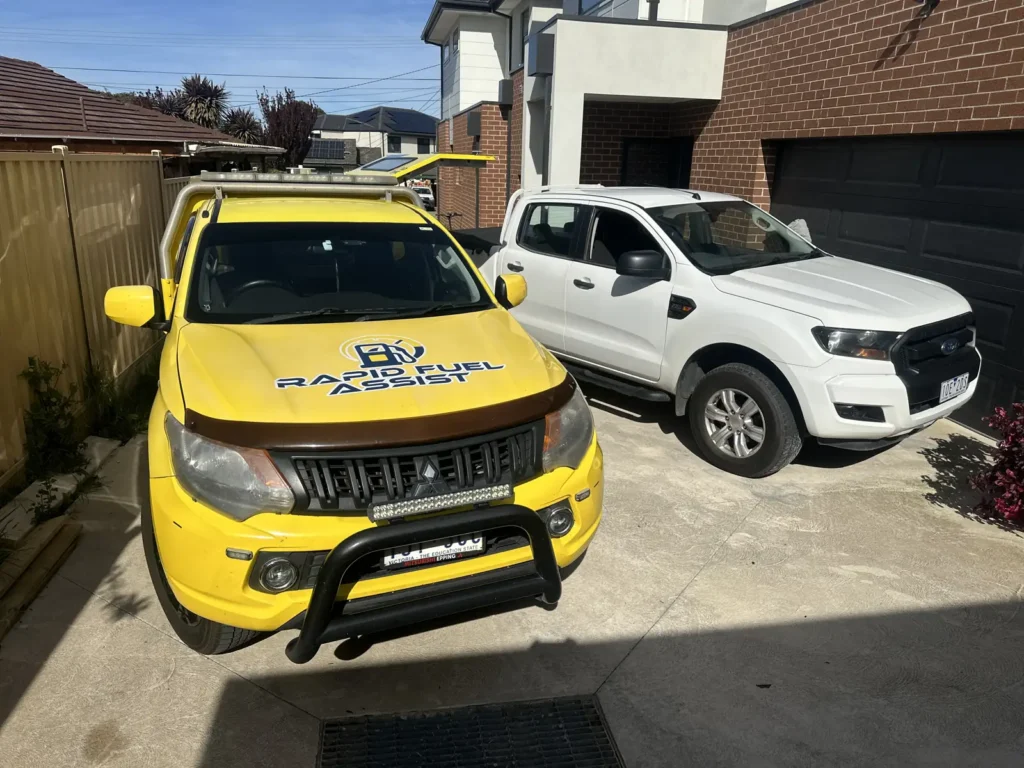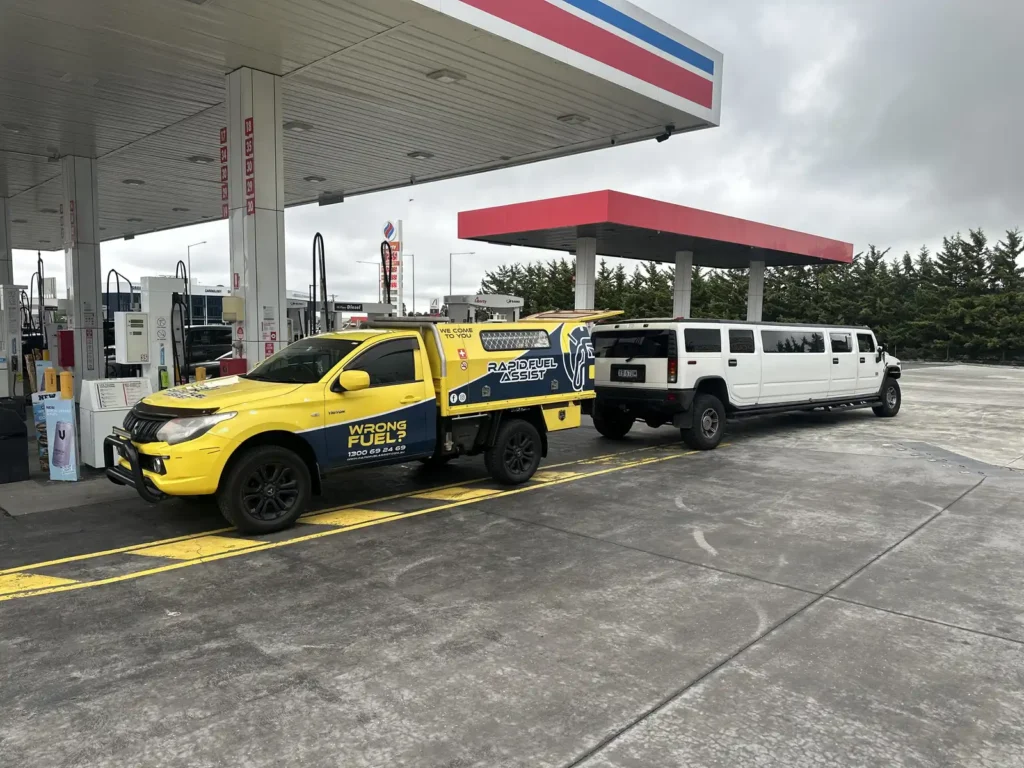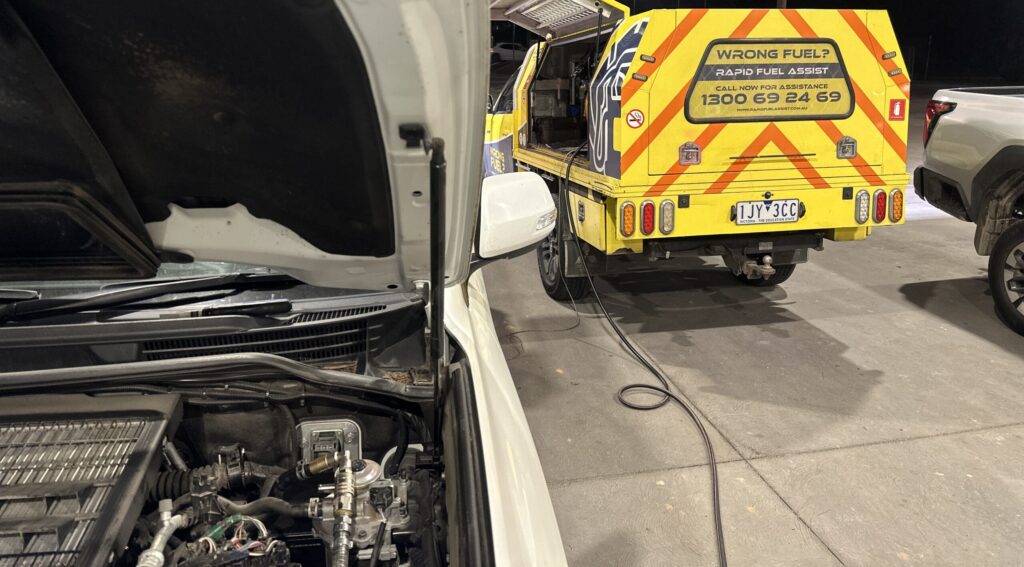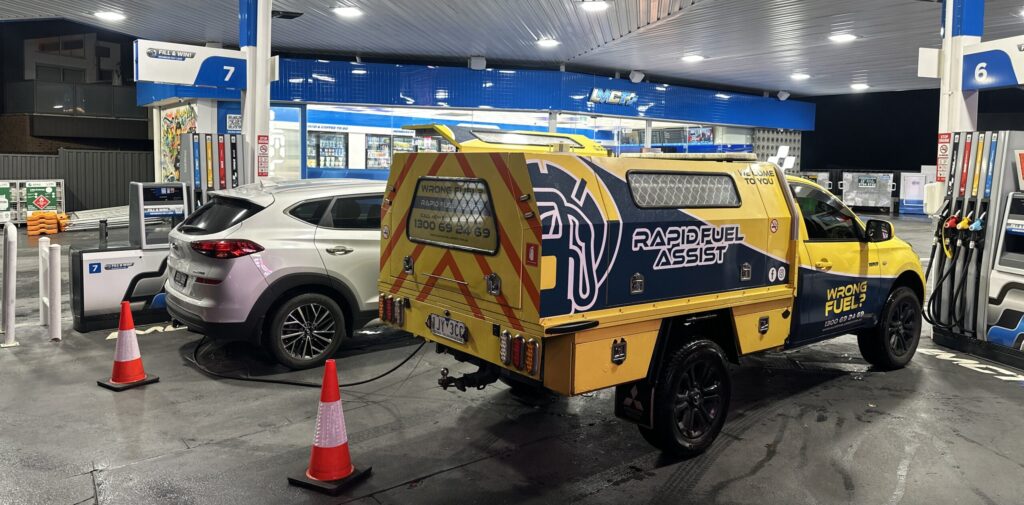

Quick answer: zero kilometres. If you have put petrol in a diesel, don’t start the engine, and if you are already driving, pull over and turn it off. Most cars we attend are fixed on the spot with a drain and flush, and the standard price is a fixed $450 when the car is still at the fuel pump.
How far should you drive? Well the answer is zero. The real answer is — it depends, and that ambiguity is exactly what makes this question dangerous.
We remobilise thousands of vehicles a year at Rapid Fuel Assist. A significant portion of those cars have been driven after the wrong fuel was added. Some had covered a few hundred metres. Some had driven across suburbs. One had travelled close to 100 kilometres before breaking down on the side of the road. What we can tell you from that experience is this — driving on petrol in a diesel engine is never without consequence, and the further you go the closer you move toward a failure that cannot be undone at the roadside.
Here is what actually happens when petrol gets into a diesel engine, why so many drivers end up driving further than they should, and what we find when we attend.
Why the Answer Isn’t as Simple as “Stop Immediately”
Most advice on wrong fuel tells you to stop the car and call a specialist. That advice is correct. But it doesn’t explain what actually happens when people don’t stop — and understanding that is important, because the reality of petrol in diesel contamination is not a simple linear scale where every kilometre causes a defined amount of damage.
The outcome depends on a number of variables: how much petrol went into the tank relative to diesel already present, the specific fuel system design of the vehicle, how hard the engine was worked, how long it was at operating temperature, and whether the vehicle was left to cool down and restarted.
A car with a quarter tank of diesel already in it that received a 20 litre petrol top-up is in a different situation to a car running on a nearly empty tank that received a full fill of petrol. A modern high pressure common rail diesel system is more sensitive to fuel contamination than an older injection system. These factors all influence how quickly damage progresses and how far the car will actually run before symptoms appear — or before it stops running altogether.
What does not change is the direction of travel. Every kilometre driven on contaminated fuel moves the vehicle further toward component damage. There is no safe distance. There is only a range of outcomes, and all of them are worse than stopping immediately.
It is not just what we see on the job either. Australian drivers sharing their own experiences on forums like Reddit paint the same picture — some cars cut out within a kilometre, others keep running for far longer before the damage catches up. The variables are real and the outcomes are genuinely unpredictable.
What Petrol Actually Does to a Diesel Fuel System
Diesel fuel is not just a combustion fuel — it is also a lubricant. The high pressure fuel pump and injectors in a diesel engine rely on diesel’s viscosity and lubricating properties to operate. Petrol has neither. It is thinner, it burns differently, and in a diesel fuel system it acts as a solvent rather than a lubricant.
At low contamination levels the pump and injectors are running without adequate lubrication. Metal components that depend on the film of diesel fuel to prevent direct contact begin to wear against each other. At higher contamination levels or after extended running, this wear accelerates. The pump struggles to maintain the pressures a modern common rail system requires — often 2,000 bar or more — and the injectors begin to fail.
There is another issue that becomes relevant once the engine reaches operating temperature. Diesel engines use compression ignition — the fuel ignites from the heat generated by compressing air in the cylinder, not from a spark. Petrol has a lower ignition point and different combustion characteristics. At operating temperature, petrol contamination can cause pre-ignition — the fuel igniting before the piston reaches the correct position in its stroke. This creates incorrect combustion timing, excessive cylinder pressures and significant mechanical stress on engine components that are not designed to handle it.
This is one reason why a vehicle that appeared to be running acceptably when first started can deteriorate significantly once the engine is fully warmed up — and why a vehicle driven for an extended distance can sustain damage beyond what a fuel system flush can resolve.
Why So Many Drivers End Up Driving Further Than They Should
So, How Far Can You Drive on Petrol in Diesel — The Honest Answer
This is the part that most wrong fuel articles do not explain, and it is genuinely important to understand.
Many modern diesel vehicles have an electric lift pump that begins circulating fuel through the system the moment the key is turned — even just to the accessories position, before the engine is started. On these vehicles, fuel can reach the injectors before the engine has even fired. Other vehicles only activate the high pressure pump on engine start, meaning that turning the key to accessories carries lower risk. Unless you know your specific vehicle’s fuel system design, the safest position is to leave the key out of the ignition entirely and wait for advice.
The bigger issue is what happens in the fuel lines and filter housing. That section of the system typically holds one to two litres of clean diesel — the fuel that was already in the lines before the contaminated tank was added. When a driver starts the engine after a misfuel, that clean fuel is what the engine runs on first. The engine starts normally. It idles smoothly. It pulls away from the servo without complaint.
This leads drivers to conclude that the car is fine. Some make a conscious decision to keep driving and see what happens. Others simply do not realise the mistake has been made at all. By the time the contaminated fuel from the tank reaches the injectors — which can take several minutes of driving — the driver may be well away from the servo, on a freeway, or nearly home.
Once the engine is at operating temperature and running on contaminated fuel, some drivers notice immediately — loss of power, rough running, smoke from the exhaust. Others notice nothing at all. Either way, the fuel system is under stress it was not designed to handle. And a vehicle that makes it home, parked up and left to cool overnight, will very often not start again the next morning. The cold restart after contaminated fuel has sat in the system is frequently when the mistake finally reveals itself.
What We Actually See When We Attend
Mercedes ML350 — BP Rockbank to Melton
A customer filled around half a tank with petrol at a BP near Rockbank, with diesel already in the tank. He started the car and it ran normally — the clean fuel already in the lines doing its job. By the time he reached the freeway the engine was running very poorly, but he was close enough to home that he made the call to push through. He arrived in Melton, shut the car off, and immediately knew that driving it had been a mistake. He had started the car at the servo, observed it running fine, and made the decision to drive — a decision he regretted as soon as the symptoms appeared on the freeway.
We attended, completed a full drain and flush, and remobilised the vehicle without replacement parts. Fuel pressures were checked, engine function assessed, and the ML350 drove away under its own power. Whether that vehicle will experience accelerated wear on the pump or injectors in the future is harder to answer — the exposure was significant and the contamination ratio was high.
Nissan Navara — Malvern to Cheltenham
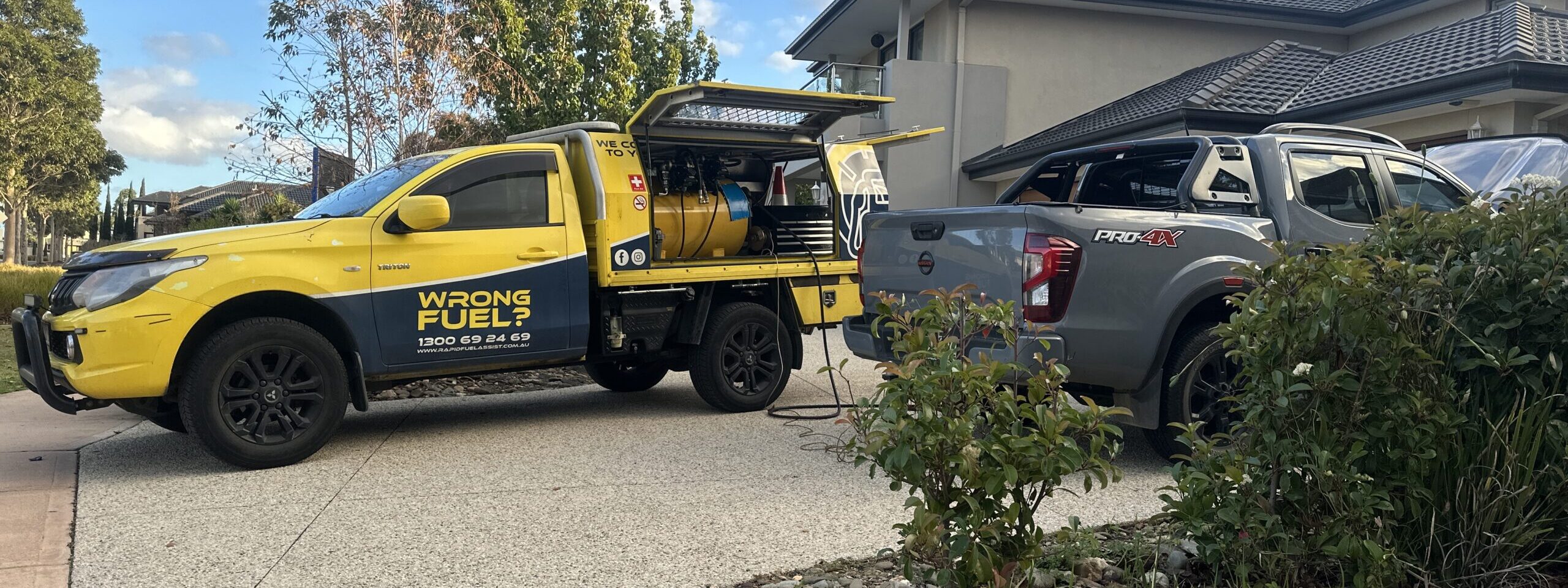
This customer did not notice anything wrong at all. Filled up at a service station in Malvern, drove home to Cheltenham, and parked up as normal. The next morning the Navara would not start. Tracing the steps back they recognised the mistake and called us.
This is a scenario we see regularly. The contamination ratio was enough for the car to run the entire trip home without obvious symptoms — the driver was not attuned to the subtle change in engine behaviour that a wrong fuel mix produces, and the car gave no clear warning. The cold restart the following morning was what revealed the problem. We explain why in wrong fuel and the car won’t start the next morning.
We attended, drained and flushed the system, and had the Navara running again. No parts replacement required.
The Extreme End — What 100 Kilometres Looks Like
We have attended vehicles driven close to 100 kilometres on petrol in diesel. In one case a Toyota HiAce was filled in regional northern Victoria and the driver headed south toward Melbourne. The engine began running poorly but the driver did not stop until a service station much further along the route — at which point the engine would not restart at all. By that stage the contaminated fuel had been running through a hot, loaded engine for an extended period, with the pre-ignition and fuel system stress that comes with it. We were able to remobilise the vehicle. But a car driven that distance on contaminated fuel carries a realistic likelihood of premature component wear that may not present as an immediate failure but will shorten the service life of those parts considerably.
It is worth noting — we never attend a job and immediately call an injector or fuel pump failure without evidence. Our process is always to drain and flush first, then assess fuel pressures and engine function before drawing any conclusions. That approach has resolved situations that looked severe from the outside. The dealership that quoted $4,300 for injector replacement on a Ford Ranger that we fixed on the spot for $500 is a good example of how premature that call often is.
A Note on Topping Up With Diesel
One scenario worth addressing specifically: a driver who adds petrol, realises the mistake, and decides to top the tank up with diesel to dilute the contamination. We see this regularly. It does not help. Topping up with diesel does not undo the contamination — it simply means there is more total volume to drain when we arrive. You are spending money on diesel that goes straight into our waste disposal drums. Stop at the misfuel, leave the tank as it is, and call us.
What to Do If You Have Already Driven
If you are reading this because you have already driven on petrol in diesel — stop the vehicle now if you have not already. Turn the engine off and do not restart it.
The fact that you have driven does not mean the situation is unrecoverable. The majority of vehicles we attend that have been driven are remobilised on the spot without parts replacement. What matters now is stopping the damage from progressing any further.
Call Rapid Fuel Assist on 1300 692 469. We will come to your location anywhere across Melbourne, from Melton, Werribee and Point Cook in the west to Dandenong, Frankston and Cranbourne in the south-east, plus Geelong and regional Victoria. We assess the system properly, drain and flush the contaminated fuel, and give you an honest picture of the vehicle’s condition. We attend 7 days a week with fixed pricing: most jobs are $450 when the car is still at the fuel pump, or $475 if it has been driven home or broken down on the road. No fix, no fee.
The sooner you stop and call, the better the outcome. That is the one variable you still control.
Put the wrong fuel in your car in Melbourne? Don’t start the engine. Call Rapid Fuel Assist on 1300 692 469 — mobile, fast, fixed pricing, 7 days across Melbourne Metro.
Which Situation Are You In?
- Put wrong fuel in but didn’t start the engine
- You started the engine at the servo
- You are already driving on the freeway
- The car won’t start the next morning
- What to do in the first 5 minutes
Frequently Asked Questions
How far can you drive with petrol in a diesel engine?
Zero kilometres is the safe answer. The fuel lines and filter hold one to two litres of clean diesel, so the car may start and drive normally for a few minutes. Once the petrol reaches the high pressure pump and injectors, they run without lubrication and damage starts. There is no safe distance.
I’ve already driven on petrol in diesel. Is my engine ruined?
Not necessarily. Most vehicles we attend that have been driven are fixed on the spot with a drain and flush, with no parts replaced. Stop now, turn the engine off and don’t restart it. We check fuel pressures and engine function before making any call on the pump or injectors.
Should I top up with diesel to dilute the petrol?
No. Adding diesel doesn’t undo the contamination. It only adds more fuel that has to be drained and disposed of. Leave the tank as it is and call us.
How much does it cost to fix petrol in a diesel in Melbourne?
Most jobs are a fixed $450 when the car is still at the fuel pump, or $475 if it has been driven home or broken down on the road. The price is quoted on the phone, includes GST and has no card fees. A started engine doesn’t change the price, and it’s no fix, no fee. See our 2026 price guide for larger vehicles and regional areas.
Do you come out to my suburb?
We cover all of Melbourne 7 days a week, including the western suburbs like Melton, Werribee and Point Cook, and the south-east like Dandenong, Frankston and Cranbourne. We also attend Geelong and regional Victoria. Call 1300 692 469 and we’ll give you an arrival time.
Related Reading
Petrol in Diesel Car Melbourne: Our Service
The Dealership Quoted $4,300. We Fixed It for $500. Here’s the Full Story.